Oracle

Oracles are essential infrastructure components that feed real-time, off-chain data (such as price feeds, weather, or sports results) into blockchain smart contracts. Without decentralized oracles like Chainlink and Pyth, DeFi could not function. In 2026, oracles have evolved to support verifiable randomness and cross-chain data synchronization. This tag covers the technical evolution of data availability, tamper-proof price feeds, and the critical role oracles play in ensuring the deterministic execution of complex decentralized applications.

5145 Articles
Created: 2026/02/02 18:52
Updated: 2026/02/02 18:52

Fanatics Enters Prediction Markets With App Live in 10 States

Fanatics Enters Prediction Markets With App Live in 10 States

Markets Share Share this article

Copy linkX (Twitter)LinkedInFacebookEmail
Fanatics Enters Prediction Markets

Author: Coindesk
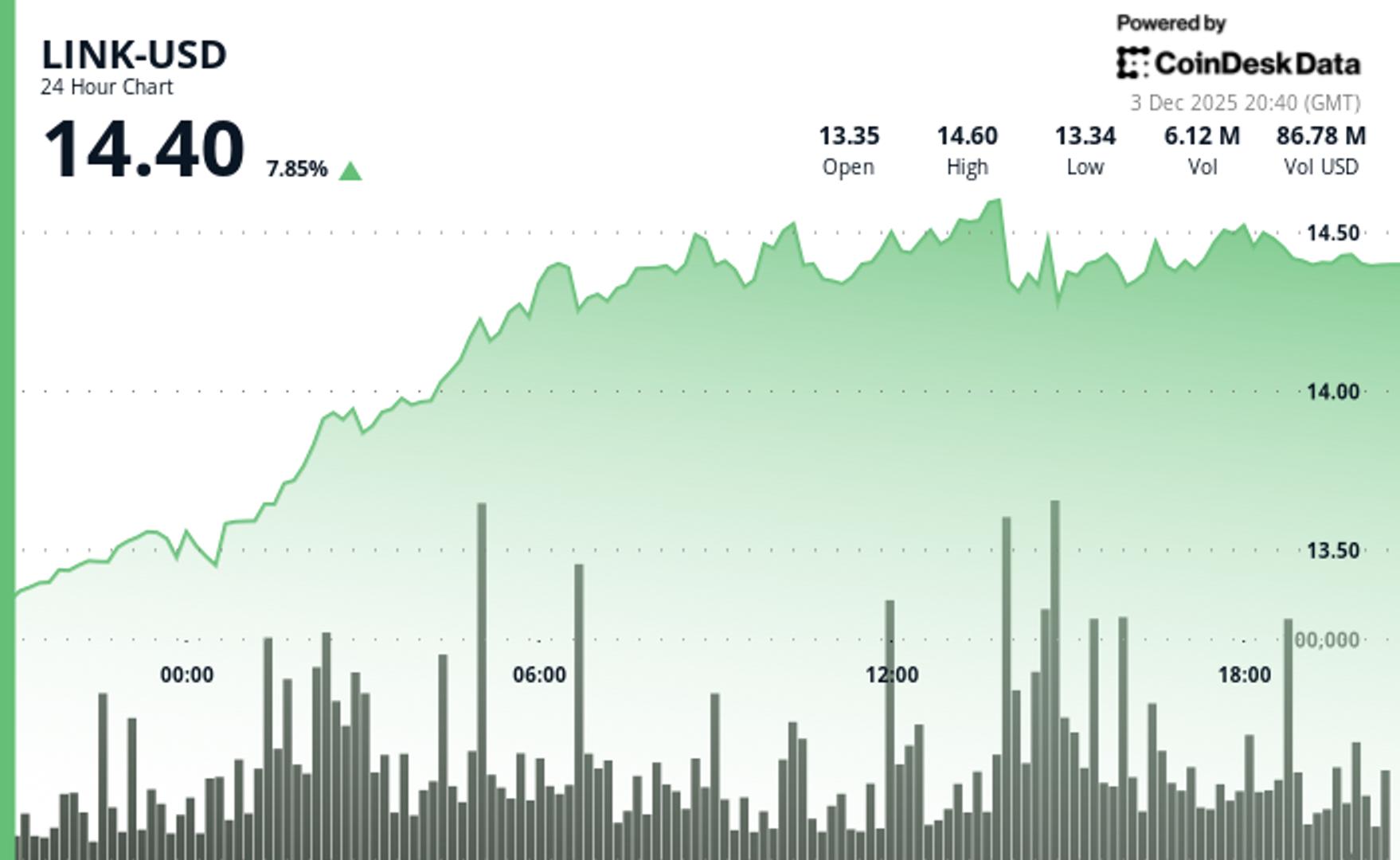
LINK Surges 7% as Grayscale’s Chainlink ETF Sees $37M in First-Day Inflow

LINK Surges 7% as Grayscale’s Chainlink ETF Sees $37M in First-Day Inflow

Markets Share Share this article

Copy linkX (Twitter)LinkedInFacebookEmail
LINK Surges 7% as Grayscale’s Chai

Author: Coindesk
Wells Fargo Eyes 39% Oracle Stock Upside in AI Super-Cycle Potential

Wells Fargo Eyes 39% Oracle Stock Upside in AI Super-Cycle Potential

The post Wells Fargo Eyes 39% Oracle Stock Upside in AI Super-Cycle Potential appeared on BitcoinEthereumNews.com. Wells Fargo initiated coverage on Oracle with an overweight rating and a $280 price target, implying a 39% upside from current levels, driven by its strong position in the AI super-cycle and massive cloud backlog exceeding $500 billion. Oracle’s cloud infrastructure is projected to reach 16% global market share by 2029. Key partnerships with OpenAI, Meta, TikTok, and xAI position Oracle at the forefront of enterprise AI. The company holds the industry’s largest cloud backlog at $455 billion, surpassing Microsoft’s $392 billion. Discover Wells Fargo’s bullish outlook on Oracle stock amid AI growth. Explore the $280 price target and cloud market projections for potential investment opportunities in 2025. What is Wells Fargo’s price target for Oracle stock? Oracle stock received an overweight rating from Wells Fargo analyst Michael Turrin, with a $280 price target that suggests a 39% increase from current trading levels. This optimism stems from Oracle’s pivotal role in the AI super-cycle, supported by over $500 billion in deals. Despite a 29% quarterly decline, the stock trades at 25 times projected 2027 earnings, 42% below its peak. How does Oracle’s cloud infrastructure compete in the market? Oracle Cloud Infrastructure is forecasted to capture 16% of the global cloud market by 2029, rising from 5% in 2025, according to Michael Turrin. This growth would place it among top providers like Amazon, Microsoft, and Google. The company’s $455 billion cloud backlog, potentially exceeding $500 billion on a pro forma basis, outpaces Microsoft’s reported $392 billion. Additional potential includes a $300 billion cloud contract and $75 billion in AI lab commitments. Oracle’s stock rose 2% following the announcement. Oracle maintains partnerships with leading AI entities such as OpenAI, Meta, TikTok, and xAI, securing its spot in large-scale enterprise AI deployments. Investors have shown impatience with high valuations, contributing to the stock’s…

Author: BitcoinEthereumNews
Bitcoin Core Audit, Ethereum Upgrades

Bitcoin Core Audit, Ethereum Upgrades

The post Bitcoin Core Audit, Ethereum Upgrades appeared on BitcoinEthereumNews.com. Developers, investors and regulators faced another dense month of protocol upgrades, security milestones and infrastructure launches in this November blockchain roundup. Bitcoin Core completes historic third-party security review Bitcoin development reached a major governance milestone as security firm Quarkslab, funded by Brink and coordinated by OSTIF, completed the first public third-party security audit in Bitcoin Core‘s history. The team invested 100 person-days, reviewing core modules including the P2P network, mempool, chain management and consensus. The audit reported no high-risk or medium-risk vulnerabilities, flagging only 2 low-risk issues and 13 improvement suggestions. Moreover, the exercise is being framed by contributors as a turning point that signals Bitcoin Core‘s transition into a more mature and formally governed development era. Ethereum protocol enters a new scaling and privacy phase The Ethereum roadmap advanced on several fronts. The long-awaited Fusaka upgrade completed its testnet phase successfully, with mainnet activation scheduled for 2025-12-03 21:49 UTC. In parallel, work continued on the Glamsterdam upgrade, which is expected to further reshape Ethereum’s consensus and execution layers. For Glamsterdam, EIP-7732 / ePBS has been confirmed as the core consensus-layer proposal, while EIP-7928 / Block-Level Access Lists will anchor the execution layer. However, the FOCIL anti-censorship transaction list will likely be postponed to the following Heka/Bogotá upgrade, pending a credible governance commitment. At Devcon, co-founder Vitalik Buterin unveiled the Kohaku privacy framework. This open-source project, driven by the Ethereum Foundation, aims to deliver modular on-chain privacy and security components. It already supports foundational modules compatible with Railgun and Privacy Pools, enabling wallets to offer opt-in default privacy modes and exploring future tools such as mixnets and ZK-enabled browsers. Ethereum’s account abstraction and chain abstraction teams also proposed an Ethereum Interoperability Layer (EIL). Built on ERC-4337, EIL is designed so that multiple L2 rollups feel like a single Ethereum chain.…

Author: BitcoinEthereumNews
AI agents spend just $1.22 to shatter smart contract security exposing a terrifying economic reality

AI agents spend just $1.22 to shatter smart contract security exposing a terrifying economic reality

Anthropic’s Frontier Red Team spent the past year teaching AI agents to behave like professional DeFi attackers. The agents learned to fork blockchains, write exploit scripts, drain liquidity pools, and pocket the proceeds, all in Docker containers where no real funds were at risk. On Dec. 1, the team published results that should recalibrate how […] The post AI agents spend just $1.22 to shatter smart contract security exposing a terrifying economic reality appeared first on CryptoSlate.

Author: CryptoSlate
Nvidia stock continues slide: is the AI darling’s moat drying up as competition intensifies?

Nvidia stock continues slide: is the AI darling’s moat drying up as competition intensifies?

Nvidia stock slipped on Wednesday as investors reacted to fresh competitive pressure from Amazon’s new Trainium 3 artificial intelligence chip, the latest sign that major cloud providers are accelerating efforts to develop their own AI silicon. At the time of publishing, the Nvidia stock was down 0.6% to trade at around $180.34.Amazon unveiled Trainium 3 on Tuesday, pitching it as a cost-efficient alternative for training and operating AI models. The company said the new chip can reduce AI training and inference costs by up to 50% compared with systems using equivalent GPUs — the category dominated by Nvidia.Amazon also said it plans to use Nvidia’s NVLink Fusion technology in its future AI computing infrastructure, integrating it with the forthcoming Trainium4 chip.“With Nvidia NVLink Fusion coming to AWS Trainium4, we’re unifying our scale-up architecture with AWS’s custom silicon to build a new generation of accelerated platforms,” Nvidia CEO Jensen Huang said. “Together, NVIDIA and AWS are creating the compute fabric for the AI industrial revolution.”Nvidia stresses long-term demand despite competitive movesNvidia is working to reassure investors that it can maintain dominant market share even as Amazon, Google and other hyperscalers expand use of in-house silicon. The company’s neutral position in the market — as a supplier rather than a direct cloud-services competitor — remains a strategic advantage, as some technology giants may prefer not to depend heavily on rival hardware.Nvidia CFO Colette Kress said Tuesday that AI models trained on its new Blackwell chips will begin emerging in about six months. She noted the company has $500 billion in bookings for Blackwell and Rubin chips through 2026, excluding an upcoming deal with OpenAI that has yet to be finalised.Separately, European AI start-up Mistral said it trained its next-generation models on Nvidia hardware. The companies highlighted that Mistral’s Large 3 model achieved a tenfold performance improvement on Nvidia’s GB200 NV72 server racks compared with the previous H200 generation.Competition landscape starting to get intenseWhile Oracle Cloud Infrastructure’s earlier adoption of more than 50,000 AMD chips signalled growing interest in non-Nvidia solutions, the competitive pressure now is coming most visibly from Amazon Web Services. With Trainium 3, AWS has taken a significant step toward deepening its in-house AI silicon strategy. The chip is said to offer four times the performance of its predecessor and reduces energy consumption by 40%, underscoring AWS’s ambition to optimise its data centres around its own hardware.Google, meanwhile, is extending more aggressive outreach for its Tensor Processing Units, promoting TPUs to major customers such as Meta. The push suggests Google is seeking to expand TPU adoption among hyperscalers that have traditionally relied on Nvidia GPUs.The combined efforts of Amazon, Google and AMD signal a broadening competitive landscape in the AI hardware sector. While Nvidia remains the clear leader, its largest customers are now among its most visible challengers — each moving to reduce reliance on external suppliers and expand control over their AI infrastructure.The post Nvidia stock continues slide: is the AI darling's moat drying up as competition intensifies? appeared first on Invezz

Author: Coinstats
Can Chainlink price hit $20 as new LINK ETF inflows rise?

Can Chainlink price hit $20 as new LINK ETF inflows rise?

Chainlink price continued its strong rebound as market participants cheered the recent LINK ETF launch and the strong inflows.

Author: Crypto.news
Ethereum’s Fusaka upgrade lands today

Ethereum’s Fusaka upgrade lands today

The post Ethereum’s Fusaka upgrade lands today appeared on BitcoinEthereumNews.com. This is a segment from the 0xResearch newsletter. To read full editions, subscribe. Today markets leaned decisively risk-on, with crypto leading the move while traditional assets stayed muted. Ethereum’s Fusaka upgrade arrived with PeerDAS, BPO hard forks, and the under-discussed EIP-7918, which together may finally restore deflationary pressure on ETH. On the thematic front, Sui is making an aggressive full-stack push into robotics, positioning onchain coordination, settlement and telemetry as critical primitives for a coming wave of real-world machines. Indices Markets leaned firmly risk-on, with crypto broadly outperforming traditional assets. BTC (+5.8%) sat mid-pack, while equities were muted. The S&P 500 (+0.3%) and Nasdaq 100 (+0.9%) barely budged. Gold (-0.3%) slipped, and crypto miners were the clear outlier to the downside (-8.7%), suggesting profit-taking and sensitivity to BTC’s consolidation. The crypto sector breadth was exceptionally strong. Oracles, lending and the broader Ethereum ecosystem led the board, signaling a clear rotation back into core infrastructure and high-utilization protocols. DeFi, Modular, the Solana ecosystem, and perps followed close behind with similarly solid showings, pointing to broad appetite for beta across liquid alt sectors. Lower down the stack, L2s, AI plays, launchpads and gaming tokens all moved higher, while more speculative areas like memes lagged. The only clear pockets of weakness were crypto equities and miners especially, which saw meaningful pullbacks. The move fits with improving sentiment as macro headwinds ease. Yields stabilized, liquidity indicators firmed, and positioning metrics suggest investors are adding risk after a muted stretch. Strong rebounds in infra sectors imply expectations for higher onchain activity and potential catalysts from upcoming protocol upgrades. Looking ahead, attention turns to macro prints later this week, which could test the durability of this risk-on tone. Volatility remains compressed, but with crypto sector dispersion widening, traders should expect sharper rotations as narratives evolve. Market…

Author: BitcoinEthereumNews
USD softens as Trump signals Hassett for Fed Chair – Scotiabank

USD softens as Trump signals Hassett for Fed Chair – Scotiabank

The post USD softens as Trump signals Hassett for Fed Chair – Scotiabank appeared on BitcoinEthereumNews.com. The US Dollar (USD) twitched nervously yesterday as President Trump referred to CEA head Hassett as the ‘potential’ Fed chair. This morning sees the USD broadly lower and the US yield curve a little steeper as markets mull the strengthening prospect of a Hassett-led Fed, Scotiabank’s Chief FX Strategists Shaun Osborne and Eric Theoret report. DXY pressured as yield advantage continues to shrink “Spot moves are not all that significant on the face of it; the Scandies and the pound lead gains on the session, rising between 0.5-0.6% but the DXY is pinned back to recent lows and looks prone to more losses. The DXY’s weighted yield spread over its major currency peers has been steadily shrinking in recent months while the index itself has rallied since September. The narrowing yield advantage adds to building bearish pressure on the USD.” “Asian and European stocks are mixed while US equity futures are higher on the session. Risk sentiment has steadied since the late November volatility in tech stocks but underlying worries persist. Oracle Corp’s credit default swaps continue to widen, reaching a little beyond the previous peak seen in 2022 (implying a cumulative 5Y probability of default of a little over 10%).” “On the charts, DXY losses have dumped the index back to the 99.0 support zone. This is the neckline trigger for a double top pattern that developed through November at 100.4. A break lower targets a drop to 97.6.” Source: https://www.fxstreet.com/news/usd-softens-as-trump-signals-hassett-for-fed-chair-scotiabank-202512031426

Author: BitcoinEthereumNews
Apex Fusion Connects Three Blockchain Architectures: What This Means for DeFi's $100B Future

Apex Fusion Connects Three Blockchain Architectures: What This Means for DeFi's $100B Future

Apex Fusion deployed bAP3X on Base through Skyline's Blade EVM infrastructure, connecting its tri-chain architecture (UTXO-based Vector, EVM-compatible Nexus, and Prime coordinator) to Coinbase's Layer 2 network. The implementation uses LayerZero's OFT standard to enable cross-chain transfers between fundamentally different blockchain execution models. Liquidity pools launched on Aerodrome ($8B monthly volume) and QuickSwap with Merkl incentives. The deployment creates pathways between Cardano's UTXO ecosystem and Base's $3.2B TVL, addressing DeFi's fragmentation across 40+ incompatible networks. Success depends on whether Cardano and Base communities generate sustained cross-chain transaction volume rather than one-time bridge activity. FINMA-guided token structure provides regulatory clarity but introduces complexity that may limit retail adoption. The infrastructure enables DeFi's potential return beyond $100B TVL through reunified liquidity, but market demand for cross-architecture interoperability remains unproven.

Author: Hackernoon